
Business / Professional
Online Meetings Have Their Own Rules — Here's How to Look Convincing
Video meetings are not just a room moved to a screen. They have their own visual grammar — and clothing that works in person often does not work on camera.
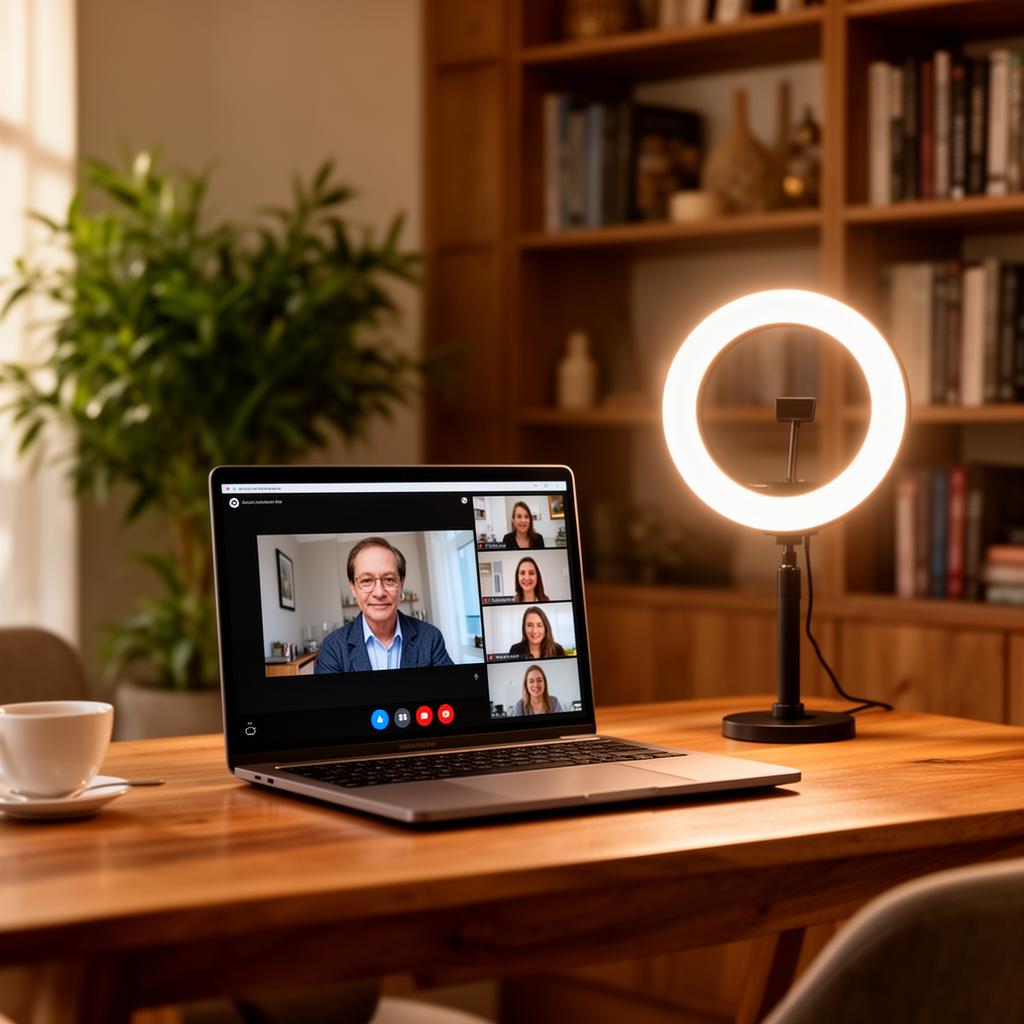
In 2020, millions of professionals were thrown into a medium no one had prepared them for. The issue was not technology — Zoom and Teams were relatively simple. The issue was that their communication habits, built over decades in rooms with people, suddenly had to work in a completely different medium.
This is not a "temporary" issue. Video meetings are not going away. For many professionals — sellers, consultants, managers, experts — a substantial share of important meetings is online. Which means we need to understand what changes about visual presence on screen.
The study that started the conversation
In September 2023, researchers at Durham University (the same institution that did the Olympic red studies) published in PLOS One a paper titled "Virtual first impressions: Zoom backgrounds affect judgements of trust and competence."
They showed participants short videos of people in different backgrounds and asked them to rate trustworthiness and competence. The findings:
Backgrounds with books and plants received the highest ratings on both dimensions.
Home backgrounds (visible kitchen, bed in the background) and novelty backgrounds (comically decorated) received the lowest ratings.
Smiling faces were rated as more trustworthy and competent than neutral ones — but interestingly, this effect reversed in work contexts where expectations called for a serious expression.
One sentence from the study deserves repeating: professionally dressed job candidates received 97% hire recommendations versus 14% for casually dressed — and this effect carries into online environments.
What others actually see when you are on screen
Here is the mechanical thing to understand: on screen you do not see what you see in a room. The field of view is dramatically smaller. Mostly they see your face and the upper torso. Posture, gesture, movement — all sharply reduced or invisible.
That means the signals that make a difference are fewer in number, and each one carries more weight.
In a room, a poorly chosen pair of trousers can be compensated by your posture, eye contact, energy. On screen — the trousers are invisible, but the upper half of your body is read through every detail.
The specific adjustments that make a difference
From video meeting research and from work with clients who operate primarily online, here is what deserves attention:
Contrast between you and the background is priority number one. On screen your face reads through contrast. Wear a tone that blends into the background, and your face "slides" visually and the sense of presence weakens. I often see people in light blouses against white walls — and their presence looks ghostly. A more saturated piece on the same background transforms presence entirely.
The choice of top matters more than the jacket. In a room, the whole silhouette tells the story. On screen — the top does almost all the work. Neckline, neck shape, fabric, color, every small detail reads in close-up. Styling for video meetings demands detail that in a room would be excessive.
Fabrics change on screen. Shiny materials reflect light and create problems. Too matte — they look cheap. Textures that work beautifully in a room can look poor on a low-resolution screen. This is one reason people with a well-chosen room wardrobe discover that something "doesn't work" online — their wardrobe is not calibrated for the camera.
Light controls everything. This is not styling, but it is critical. Light from above or front makes a huge difference in how clothing and face read. A window behind you destroys any styling choice — you appear as a silhouette. This is an easy fix most people do not make.
The background is an extension of your clothing. This is the Durham finding. People do not separate "you" from "your surroundings" — they read them together. A tidy background with a few signature elements (books, a plant, a painting) communicates together with the clothing. A messy background sabotages every other effort.
What popular literature does not say
A few things about online meetings get less discussion but matter:
First — Zoom fatigue is real and it affects you, not just those you speak to. By your seventh video meeting of the day, your expressions, energy, posture — all weaken. Clothing done right can compensate for part of this. It matters how representatively dressed you feel. So clothing for video meetings works in two directions: how others see you and how you feel yourself.
Second — asynchronous viewing is reality. More and more important meetings get recorded and viewed by people who were not present. Your clothing for a 9 a.m. Friday video meeting may be watched by a senior executive on Sunday evening. That changes how you should think about the choice.
Third — many online meetings are with professionals you do not know. In a room, people see you in your office, in a context that anchors them. On screen you have no such anchor. Your clothing and background become the entire context.
What to do tomorrow
If you have important online meetings and have not thought about this consciously, here is the starter kit:
Test every position in your wardrobe in front of your camera before wearing it to an important meeting. What works in the mirror in natural light may not work on video under standard office lighting. Twenty minutes of experiment once — and you know what works.
Build a "video wardrobe" — three to four combinations you have tested and know work on camera, in your specific background, under your specific lighting. When you have the meeting and are under pressure, you do not want to be deciding what to wear.
Watch recordings of yourself. It is uncomfortable but illuminating. Recordings show what others actually see — and it is often surprisingly different from what you imagine.
A closing thought
Video meetings are a medium. They have laws that are not the same as the laws of the room. People who are good "live" communicators often discover that online something does not work — not because they lack the skill, but because the skill is calibrated for a different context.
This is not a problem solved with a better microphone or camera. It is solved by understanding what your traces look like, in this specific field of view, at this resolution, on the screen at the other end.
That is the work video-meeting styling does, when done right. Not "how do I look better online." Rather "how does my presence pass through this medium without losing its substance.".
Need to discuss a styling solution?
Get in touch